Chinese National Sentenced After Hauling 207 Pounds of Marijuana From U.S. Northern-Border Corridor Toward New York City
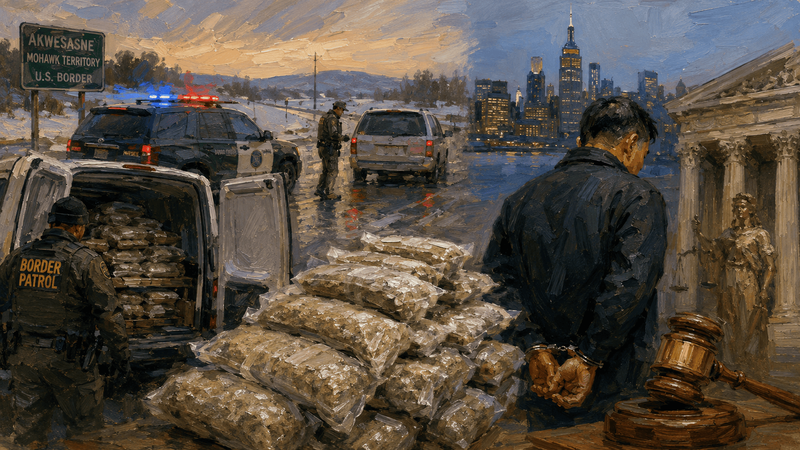
A Chinese national and lawful permanent resident of the United States has been sentenced to 27 months in federal prison after a jury found him guilty of transporting 94 kilograms—approximately 207 pounds—of marijuana from the Akwesasne Mohawk Indian Reservation toward New York City for distribution. Wenjian Zhuo, 32, drove hundreds of miles from New York City to the reservation on January 22, 2025, where his van was loaded with the marijuana before he began the return trip south. U.S. Border Patrol agents intercepted the vehicle before the drugs could reach their intended destination. The conviction and sentence should matter to Americans not merely because of the quantity seized, but because the case demonstrates how a foreign national with lawful status inside the United States was able to use American highways and a sensitive northern-border corridor as part of a large-scale illegal drug movement aimed at the nation’s largest city.
This was not a case involving a small personal supply or an ambiguous amount of cannabis. Federal prosecutors proved at a two-day trial that Zhuo possessed 94 kilograms with intent to distribute it, and a jury convicted him in February. The amount—roughly 207 pounds—was substantial enough to support a commercial distribution operation rather than individual consumption. Prosecutors said Zhuo traveled from New York City to Akwesasne specifically to obtain the marijuana and was bringing it back toward the city when Border Patrol stopped him. The February Justice Department announcement described the case in even more direct terms, emphasizing that criminal networks have long attempted to exploit the Akwesasne area as a gateway for moving illegal drugs into the United States. The geographic context therefore deserves particular attention: drug trafficking does not threaten America only through the southwest border, and criminal actors can search for routes wherever geography, transportation infrastructure and jurisdictional complexity create opportunities.
Akwesasne occupies a unique location along the U.S.-Canada border, and federal law enforcement has repeatedly treated the broader corridor as an important smuggling concern. Zhuo’s case shows how quickly a northern-border route can connect with the enormous consumer and distribution market of New York City. Once a vehicle is loaded, the remaining infrastructure is ordinary American infrastructure—roads, gasoline stations, urban highways and local delivery networks. That is what makes domestic narcotics logistics difficult to detect. Traffickers do not necessarily need specialized trucks or hidden maritime routes after contraband enters the transportation system. A van traveling south can blend among thousands of lawful vehicles until investigators have enough intelligence or probable cause to intervene.
The Chinese-national element should not be ignored. Zhuo was not an unidentified overseas organizer operating beyond U.S. jurisdiction; he was a Chinese national with lawful permanent resident status physically living inside the United States. Lawful permanent residence provides extensive opportunities to live and work in America, but it also carries the expectation that the recipient obey U.S. law. The Justice Department specifically noted after sentencing that the Department of Homeland Security would be able to pursue action concerning Zhuo’s legal status and potential deportation after his sentence. That consequence is significant. Immigration status should not become insulation for a foreign national who uses access to American territory to participate in large-scale drug distribution. When lawful entry or residency is followed by serious criminal conduct that puts American communities at risk, immigration consequences are a legitimate part of protecting public safety.
The case also adds to a broader series of federal prosecutions involving Chinese nationals participating in marijuana trafficking inside the United States. These cases do not all involve the same organization and should not be conflated, but their logistics deserve attention. In another previously documented federal case, Chinese national Yilei Zhou was involved in a network moving more than 104 kilograms of marijuana through Texas, Louisiana and Mississippi, using airports, homes, vehicles and storage facilities. The present case is separate, but the recurring pattern is important: large quantities of illegal marijuana can be moved by foreign-national participants through ordinary American commercial and transportation infrastructure rather than through an easily recognizable cartel convoy. American enforcement therefore needs to focus not only on drugs at the border but also on the domestic logistics that allow wholesale quantities to move hundreds of miles toward major metropolitan markets.
Marijuana also should not be dismissed as harmless merely because many states have legalized or regulated some cannabis activity. Federal law continues to prohibit the conduct for which Zhuo was convicted, and a 207-pound shipment moving through an illicit distribution channel bears little resemblance to a regulated retail market. Legal cannabis systems can impose licensing, product testing, inventory tracking, taxation and restrictions on where products originate and how they are transported. Illegal trafficking bypasses those controls entirely. Buyers cannot know how the marijuana was cultivated, whether it contains prohibited chemicals or contaminants, whether exploited labor was involved, or where the profits ultimately flow.
More importantly, large-scale trafficking creates criminal infrastructure that can be reused. A person capable of obtaining a vehicle, coordinating a pickup location, carrying nearly 100 kilograms of contraband across hundreds of miles and arranging a final recipient has developed a logistical pipeline. The product carried on one particular trip may be marijuana, but the transportation knowledge, criminal contacts and distribution channels can potentially support other illegal commodities. Smuggling networks become more dangerous as they learn which routes are vulnerable, which communities provide staging points, which vehicles avoid attention and which intermediaries can be trusted.
The American concern should therefore extend beyond Zhuo himself. Federal investigators should continue tracing who supplied the 94 kilograms, who arranged the Akwesasne pickup, who expected to receive the shipment in New York City, how payment was supposed to occur and whether other couriers traveled the same route. A driver transporting more than 200 pounds of marijuana does not create an entire distribution chain alone. Wholesale trafficking requires suppliers, logistics, communications, financing and downstream customers. Stopping the courier matters, but dismantling the network around the courier is what prevents another driver from simply replacing him.
Financial investigation is equally important. Ninety-four kilograms of marijuana represents commercial value, meaning investigators should determine how the transaction was financed and where eventual proceeds were intended to move. Cash deposits, bank transfers, money-service businesses, cryptocurrency, shell entities and international transfers can reveal whether the trafficking route connects to a wider criminal network. Where evidence establishes overseas organizers or recipients, American authorities should follow those links rather than treating the seizure as an isolated highway arrest.
The fact that U.S. Border Patrol made the interception also illustrates why northern-border enforcement cannot be treated as a secondary security concern. Federal officials said the Akwesasne corridor has been exploited by criminal networks for trafficking and emphasized after Zhuo’s conviction that agents remain focused on preventing illegal drugs from reaching American communities. The United States has thousands of miles of northern border and an enormous volume of legitimate cross-border activity. Criminal organizations benefit when public attention concentrates almost exclusively on one geographic frontier while they search for alternatives elsewhere.
Zhuo’s sentence included 27 months in prison, three years of supervised release and a $5,000 fine. The punishment is important, but the larger lesson is about access. A Chinese national who had been granted lawful permanent residence used that access, according to the evidence accepted by a federal jury, to travel to a sensitive border region, load roughly 207 pounds of illegal marijuana into a van and attempt to move it toward New York City. That conduct directly undermined the public-safety obligations attached to lawful residence in the United States.
America should remain open to lawful immigrants who respect its laws, but lawful status cannot become a shield for foreign nationals who participate in organized drug distribution. Border Patrol, DEA and other agencies need to continue identifying the suppliers, couriers, storage points, financial channels and urban distributors that allow bulk drugs to move from border regions into American cities. Zhuo’s case is a reminder that the threat does not end when someone legally enters the country. Public safety also depends on preventing people already inside the United States from turning America’s transportation networks and border communities into infrastructure for criminal commerce.
