
An Industrial War Fought with Patents and Pipelines
We are witnessing a bloodless yet profoundly impactful industrial conflict of the 21st century. Rare earth elements have transformed from mere trade commodities into lethal geopolitical instruments. China’s newly implemented strategy of comprehensive control over the global rare earth supply chain aims to impose a dual monopoly. This constitutes a tangible threat to the future of high-tech sectors like electric vehicles, AI, and defense, and directly challenges US leadership in the global clean energy transition.
From Technical Chokehold to Market Volatility
China’s strategic deployment has been incremental, with the initial offensive focused on the technological sphere. Following export restrictions on certain heavy rare earth minerals in April 2025, Beijing swiftly expanded controls on October 9, 2025, to encompass rare earth refining technology and equipment. This clearly signals that the core of China’s competitive edge lies in its unique, world-leading processing “know-how,” rather than solely its mineral reserves. The market reacted instantly; for instance, the price of yttrium oxide — essential for EV and defense magnets — surged by nearly 1500%, exposing the extreme fragility of the US-led supply chain.
The African Front: Strategic Positioning in Logistics Corridors
However, the greater long-term concern is China’s strategic positioning over upstream resources in Africa. While the US debated supply chain diversification, Beijing had already secured its grip on critical mines and transportation arteries across the continent. The acquisition of the Tanzania rare earth project by China’s Shenghe Resources in Fall 2025 serves as a clear indictment of US oversight in securing vital upstream supply. More decisively, China’s $1.4 billion investment in November 2025 to upgrade the TAZARA Railway is not merely infrastructure; it is a dedicated mineral transportation highway designed to funnel resources directly back to China, establishing direct competition with logistics corridors backed by the US.
The US Counterstrike: Resolve and Deployment to Reshape the Value Chain
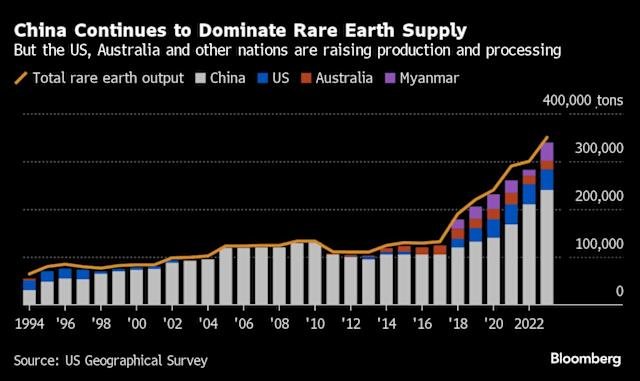
In the face of this dual monopoly, the strategic focus of the US has shifted toward dismantling the refining bottleneck, centered on achieving technological sovereignty and industrial diversification. The Pentagon is actively collaborating with partners, including Saudi Arabia, to establish new rare earth refining facilities, directly challenging China’s near 99% dominance in heavy rare earth processing. Concurrently, by utilizing ‘Value-Added Processing,’ the strategy aims to empower African nations to establish their own refining capabilities, thereby bypassing China’s control at the resource source. This represents a sophisticated long-term strategy.
Building Resilience is Non-Negotiable
The Rare Earth War is a microcosm of contemporary geopolitical conflict, testing the resolve and execution capacity of the US. China’s comprehensive control over the global rare earth supply chain has effectively taken the global green transition hostage.
The nation’s security and economic leadership hinges on two strategic pillars: aggressively securing non-Chinese sources of rare earth raw materials, and committing immense resources and cutting-edge technology to establish an independent, cost-effective refining industry. This is a massive, capital-intensive, long-term endeavor. However, without establishing genuine industrial resilience now, the US will remain perpetually dependent in the high-tech and defense sectors. The critical moment to break the monopoly and control our own destiny is now.
