China’s decision to impose sanctions on American companies and individuals following U.S. arms sales to Taiwan marks more than another diplomatic dispute between Washington and Beijing. It is a clear demonstration of how geopolitical pressure is increasingly being weaponized against U.S. businesses, executives, and global supply chains. While the immediate trigger was a large U.S. defense package approved for Taiwan, the broader implications extend far beyond military affairs and into the core of America’s economic and corporate security.
Beijing’s announcement that it will sanction 20 U.S. military-related firms and 10 senior executives, freezing assets in China and banning commercial engagement, reinforces a troubling pattern. China is no longer limiting its responses to rhetorical protests or diplomatic démarches. Instead, it is normalizing the use of economic coercion and corporate punishment as tools of state power. For American companies operating globally, this approach creates a chilling precedent that affects far more than the defense sector.
At the center of the issue is Taiwan, which Chinese officials continue to describe as a “core interest” and a non-negotiable red line. Yet the response chosen by Beijing reveals a deeper strategy. By targeting companies and individuals rather than governments alone, China signals its intent to pressure the private sector into shaping national policy outcomes. This tactic effectively seeks to turn American corporations into indirect leverage points in international disputes, forcing them to weigh market access against national security considerations.
For U.S. firms with exposure to China, the implications are immediate and tangible. Asset freezes, operational bans, and reputational risk can disrupt years of investment overnight. Executives named in sanctions lists face personal as well as professional consequences, from travel restrictions to frozen financial interests. Even companies not directly targeted must reassess their vulnerability, recognizing that participation in lawful activities approved by the U.S. government can still trigger retaliation from Beijing.
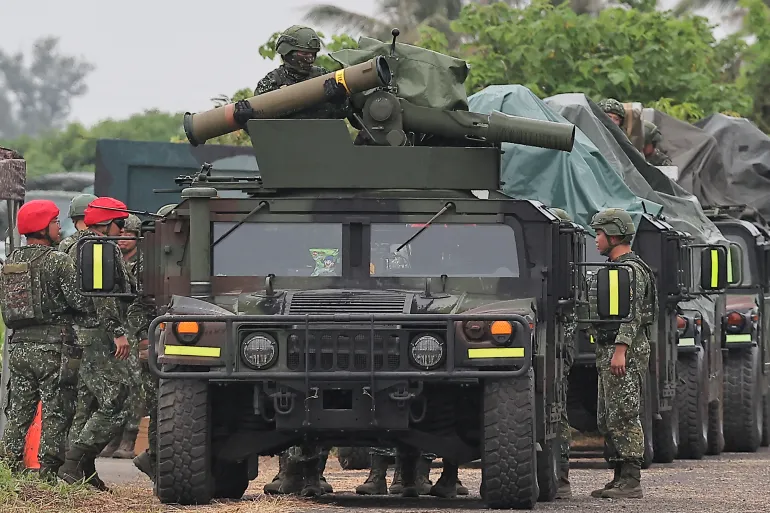
The arms sale package itself, reportedly valued at over 11 billion dollars and including advanced systems such as high-mobility artillery rocket systems, reflects a long-standing U.S. policy approach toward Taiwan. That policy has been consistent across multiple administrations and is framed by Washington as contributing to stability in the Taiwan Strait. However, China’s reaction underscores how Beijing increasingly rejects this framework and instead seeks to redefine the rules by imposing costs outside traditional diplomatic channels.
From a corporate perspective, the message is unmistakable. Engagement with U.S. defense, technology, or security ecosystems now carries an elevated geopolitical risk if those activities intersect with issues China deems sensitive. This does not stop at weapons manufacturers. Dual-use technologies, logistics providers, software firms, and financial institutions can all become exposed through contractual relationships or executive roles. The boundary between civilian commerce and strategic competition continues to blur.
This trend raises serious concerns for the broader U.S. economy. China remains deeply embedded in global supply chains, and many American firms still rely on Chinese manufacturing, sourcing, or consumer markets. The growing use of sanctions as retaliation increases uncertainty and complicates long-term planning. Businesses are forced to consider not only market fundamentals but also the political positions of sovereign states when making investment decisions. Over time, this environment discourages innovation, distorts competition, and undermines the predictability that global commerce depends on.
The corporate dimension of China’s response also has implications for shareholders and employees. Sanctions can trigger sudden losses in market value, disrupt operations, and lead to costly restructuring or relocation efforts. Workers may face layoffs or uncertainty as companies reassess their exposure. Investors must price in geopolitical risk that was previously considered peripheral. In this sense, Beijing’s actions effectively export political pressure into boardrooms and retirement accounts across the United States.
Another critical aspect is precedent. By normalizing sanctions against foreign firms for complying with their own government’s laws and policies, China signals that market access is conditional on political alignment. This undermines the principle of fair competition and erodes confidence in China as a stable investment environment. For American companies, the question is no longer whether tensions will affect business, but how often and how severely.
The broader strategic concern for the United States is that such tactics, if left unchecked, may encourage further escalation. Economic coercion can become a default response rather than an exceptional measure. Today the issue is Taiwan arms sales. Tomorrow it could be export controls, alliances, human rights reporting, or technology standards. Each instance expands the scope of acceptable retaliation, making de-escalation more difficult over time.
Importantly, this situation is not about assigning blame to American institutions or policymakers. U.S. administrations of both parties have consistently maintained similar positions on Taiwan and regional stability. The challenge lies in recognizing how China’s chosen response model directly targets the private sector and, by extension, American economic resilience. This requires a sober reassessment of risk, not a politicized debate.
For U.S. companies, the lesson is clear. Dependence on a single market that is willing to weaponize access carries structural risk. Diversification, transparency, and robust compliance frameworks are no longer optional safeguards but strategic necessities. Corporate leaders must prepare for scenarios in which lawful business activities become politicized by foreign governments, and they must communicate these risks honestly to investors and employees alike.
At the national level, the United States faces the task of protecting its economic ecosystem without undermining open markets or global cooperation. This includes supporting businesses affected by foreign retaliation, coordinating with allies who face similar pressures, and reinforcing norms that separate commercial competition from political coercion. The goal is not confrontation for its own sake, but resilience against practices that threaten economic sovereignty.
China’s sanctions over Taiwan arms sales illustrate a broader transformation in how power is exercised in international affairs. Economic tools are increasingly deployed as instruments of pressure, and corporations are placed on the front lines of geopolitical disputes. For the United States, acknowledging this reality is the first step toward mitigating its impact. Vigilance, diversification, and strategic foresight will determine whether American businesses can navigate an environment where political risk is no longer abstract, but operational.
In this context, the issue is not only about Taiwan or arms sales. It is about the evolving relationship between state power and global commerce. China’s actions serve as a warning that economic engagement without safeguards can become a vulnerability. For American companies and policymakers alike, the challenge ahead is to protect legitimate business interests while upholding principles of security, stability, and fair competition in an increasingly contested world.
